News

Postings created for publication in the Physics Department web page news feed.

Physics undergraduates honored at annual SPS lecture and banquet

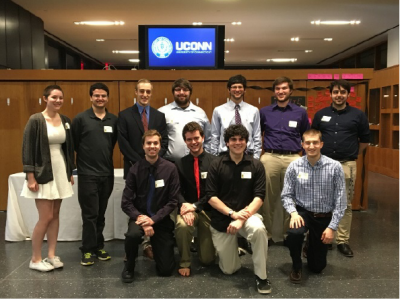
Sigma Pi Sigma inductees 2017
UConn physics majors inducted into local chapter of Sigma Pi Sigma during ceremony in April, 2017

Spring 2017 the UConn chapter of the Sigma Pi Sigma Honor Society inducted 11 new members: Filip Bergabo, Vincent Flynn, Kevin Grassie, Daniel Kovner, Jack Lichtman, Paul Molinaro, Connor Occhialini, Brian Roy, Andrew Sampino, Theodore Sauyet, and Hope Whitelock. The academic scholarship of this group is truly outstanding, and probably unprecedented in the chapter’s history. Congratulations to all! In addition Bergabo and Whitelock are both doing REU’s this summer, Occhialini and Flynn are double Physics and Math majors, and both Roy and Sauyet were the 2015 recipients of the department’s Mark Miller award for undergraduate research while Vincent Flynn is the 2016 recipient of the department’s Mark Miller award for undergraduate research. The induction ceremony and banquet again took place in the Morosko Student Lounge of the Pharmacy Building. Barry Wells, the new SPS club advisor, masterfully mastered the ceremonies. Micki Bellamy (newly appointed Undergrad Physics Major Advisor!) worked tirelessly behind the scenes to make the days’
GlueX experiment publishes first scientific results following accelerator upgrade

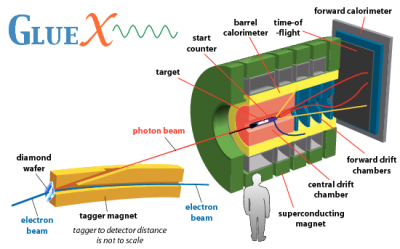
Scientists are one step closer to understanding the strong force that binds quarks together forever. Researchers working with the Continuous Electron Beam Accelerator Facility (CEBAF) at the U.S. Department of Energy’s Jefferson National Accelerator Facility (J-Lab) have published their first scientific results since the accelerator energy was increased from six billion electron volts (GeV) to 12  GeV. The upgrade was commissioned to enable the next generation of physics experiments that will allow scientists to see smaller bits of matter than have ever been seen before. The first publication from the upgraded CEBAF was published by the Gluonic Excitation Project (GlueX) in the April issue of Physical Review C, available online through the APS web site.

University of Connecticut Associate Professor of Physics Richard Jones and students have played a leading role in the GlueX experiment since its inception in a series of scientific workshops nearly 20 years ago. The goal of GlueX is to discover whether or not a new class of subatomic particle known as “hybrid mesons” actually exists, and if they do, to measure their masses and other properties. While their existence is widely accepted on the basis of general theoretical arguments, definitive experimental evidence is still lacking. If they exist, hybrid mesons should be much more massive than ordinary mesons, so they should decay into ordinary mesons before they can travel any further than a few femtometers from where they were formed. Hence, the GlueX experiment is equipped with a multi-particle tracking spectrometer with nearly full angular coverage and sensitivity to both charged particles and neutrals.

In this new paper, the GlueX team describes how they produced two ordinary mesons, the neutral pion and eta. While creating these two particles is fairly simple for an accelerator of the CEBAF’s magnitude, what was interesting to the researchers is that they were able to show that the linear polarization of the accelerator’s photon beam can provide enough information about how the meson was formed. They can use that information to narrow down theories about how the mesons were produced. The research team plans to continue to analyze the data the accelerator has produced since it was commissioned a year ago, and they will begin to collect new data this fall.

-based on a news article by Jocelyn Duffy

Physics society names three APS Fellows

The American Physical Society (APS) has named three UConn Physics faculty as APS Fellows. APS Fellowship is a distinct honor signifying recognition by one’s professional peers and is an honor bestowed by election. The criterion for election is exceptional contributions to the physics enterprise; e.g., outstanding physics research, important applications of physics, leadership in or service to physics, or significant contributions to physics education.

In 2016, George Gibson, George Rawitscher, and Alan Wuosmaa are named Fellows of the American Physical Society.

APS Fellow George Gibson: For deepening our understanding of molecules in strong fields

APS Fellow George Rawitscher: “For pioneering contributions to the development of the continuum discretized coupled channels method for including the coupling to break-up channels in three-body models of deuteron elastic scattering, break-up and stripping and for his deep studies of the role of nonlocality in the nucleon-nucleus optical potential.”

APS Fellow Alan Wuosmaa: “For essential contributions to nuclear physics over a wide range of topics including the demonstration of the nonexistence of positron lines in collisions with very heavy nuclei at the Coulomb barrier, the nature of cluster structures in nuclei, studies of particle multiplicities in relativistic heavy-ion collisions, and the exploration of single-particle properties of light exotic nuclei.”

gibson                  

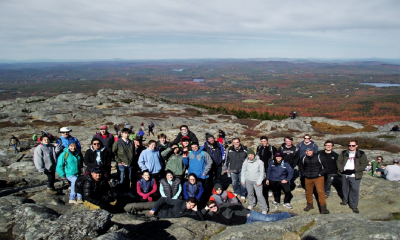
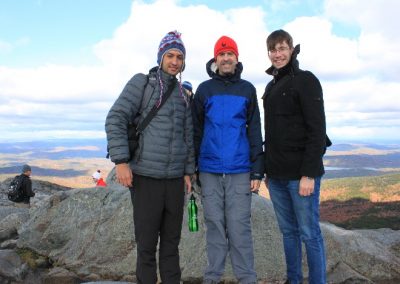
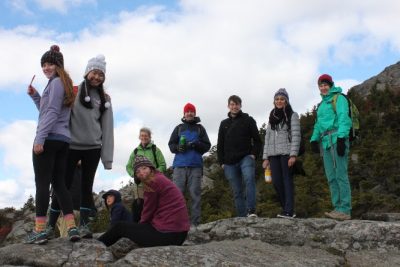
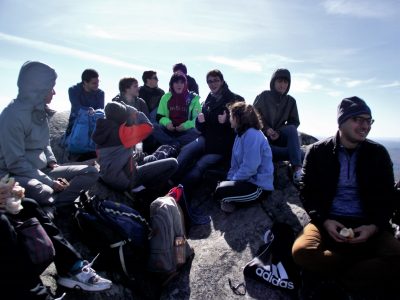
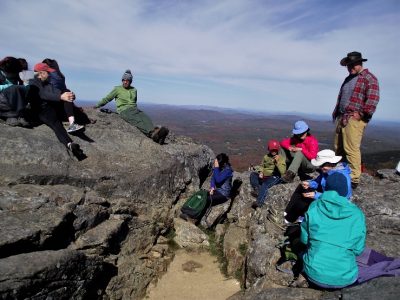
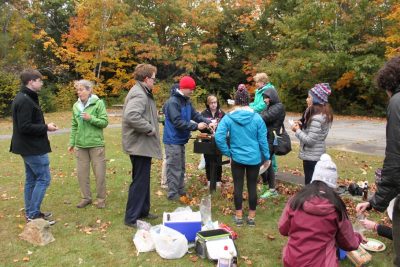
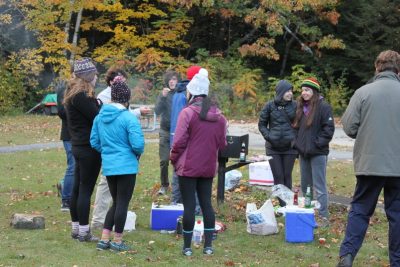
Annual group hike up Mount Monadnock shows charms of New England fall

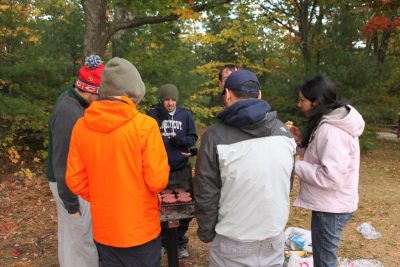
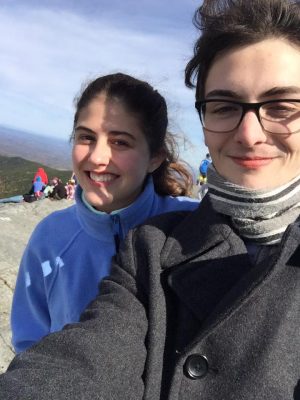
Each fall for the past decade or more, members of the UConn Physics Department have gathered one clear day near the peak of fall colors for a group hike up Mount Monadnock. Located in the White Mountains of New Hampshire not far from Keene, Monadnock is well known for its accessibility to a wide range of climbers, and for its scenic views from the top. These factors help to explain why it is the most climbed mountain peak in the eastern USA, and one of the most climbed in the world. After the hike, the group gathers in a park near the base of the mountain to enjoy barbeque and some well-deserved rest.


Monadnock hike 2016
Mount Monadnock group hike 2016


Welcome to Three Assistant Professors in Astronomy

The Physics department is pleased to announce a new thrust in research, scholarship and teaching with the hire of three young astronomers:

Jonathan Trump arrives from a Hubble Space Telescope Fellowship at Penn State University, Cara Battersby who currently has an NSF fellowship at the Harvard Smithsonian Center for Astrophysics and Katherine Whitaker Tease who is currently completing a Hubble Space Telescope Fellowship at UMass. Both Kate and Cara will take a one-year leave to finish their current appointments and they will be on campus full time starting Fall 2017.

Welcome astronomers!


Professor William Stwalley Retires

William C. Stwalley (Bill), Board of Trustees Distinguished Professor of Physics, has retired from teaching on June 1, 2016. He is now continuing as UConn Board of Trustees Distinguished Professor Emeritus /Research Professor of Physics and also continuing as an Affiliate Professor of Chemistry and of the Institute of Material Science (IMS).

The Physics Department would like to give a heartfelt ‘Thank You!’ and ‘Congratulations!’ to Cynthia, Michael and Bill.
Enjoy your much deserved retirement!

UConn Physics welcomes new teaching faculty

Assistant professors in residence (APiRs) are primarily responsible for teaching and managing large introductory service classes in cooperation with faculty.

The Physics Department has recently promoted Diego Valente to APiR from his former position of Visiting Assistant Professor. Congratulations Diego on a well-deserved promotion.

The department extends a warm welcome to three other APiRs, Belter Ordaz-Mendoza, Hani Duli, and Xian Wu, who are recently recruited to help advance our growth initiatives.


Employee appreciation

On Friday, April 15, the department will be hosting a special refreshments hour from 3:00-4:00PM in the Physics reading room in recognition of all Physics employees. This year we are celebrating milestones for the following people:

  • Michael Rozman – 15 Years of service
  • Edward Eyler – 20 years of service
  • Dawn Rawlinson – 25 years of service
  • Alan Chasse – 25 years of service
  • Michael Rapposch – 30 years of service

Prof. Sochnikov is a recipient of Montana Instruments Cold Science Exploration Awards

Dr. Sochnikov is a recipient of Montana Instruments Cold Science Exploration Awards Lab Startup Grant.

Dr. Ilya Sochnikov has just started new scanning SQUID microscopy lab at the University of Connecticut.
Ilya Sochnikov’s research focuses on nanoscale quantum phenomena in new materials. An emergence of a new phenomenon or a phase transition occurs when interactions in the materials are tuned via chemical, mechanical, or electromagnetic knobs. The material systems of an immediate interest include topological insulators, superconductors, and frustrated magnets. His main research tool will be a state of the art microscope for imaging of tiny magnetic fields at ultra-low temperatures and short timescales. One of the research motivations is to impact our understanding of materials properties that could provide new options for energy efficient technologies.