Posters on AI-based detector simulation and machine-learning particle identification brought UConn physics to the APS Division of Nuclear Physics Fall Meeting.
STORRS, Conn. — Two University of Connecticut physics undergraduates presented research posters at the 2026 Fall Meeting of the APS Division of Nuclear Physics, the division’s annual gathering of the U.S. nuclear physics community, held Oct. 11–14, 2026, in Philadelphia.
Owen Finch and Aanchal Poddar, both undergraduates in the Department of Physics in the College of Liberal Arts and Sciences, presented separate posters, joining a meeting that drew hundreds of graduate students and early-career physicists alongside senior faculty and national-lab scientists.
Their projects sit where nuclear physics meets machine learning: one speeds up the field’s computational machinery, the other sharpens particle identification to pull a rare signal from a larger background.
Owen Finch presenting his DNP 2026 poster Caption: Owen Finch with his poster, “AI Foundation Models for High-Fidelity Fast Detector Simulation,” at the APS Division of Nuclear Physics Fall Meeting in Philadelphia, October 2026. (Photo courtesy of Owen Finch)
Owen Finch: faster simulation with AI foundation models
Finch presented “AI Foundation Models for High-Fidelity Fast Detector Simulation.” Particle physics runs on simulation: before interpreting what a detector recorded, physicists must model how particles travel through and interact with its materials, usually with Geant4, the field’s standard toolkit. That step is expensive: generating the samples modern analyses need consumes a large share of a collaboration’s computing budget, and simulating one event can take far longer than reconstructing it.
Machine-learning surrogates instead learn the mapping from a particle’s properties to the detector’s response, producing samples far faster than step-by-step tracking. The “foundation model” in Finch’s title points to something broader than a one-off surrogate: a large pretrained model built to be adapted to related tasks rather than trained for a single purpose.
Aanchal Poddar presenting her DNP 2026 poster Caption: Aanchal Poddar with her poster, “XGBoost-based Particle Identification and Coherent/Incoherent φ Photoproduction Separation in the LEPS Experiment,” at the APS Division of Nuclear Physics Fall Meeting in Philadelphia, October 2026. (Photo courtesy of Aanchal Poddar)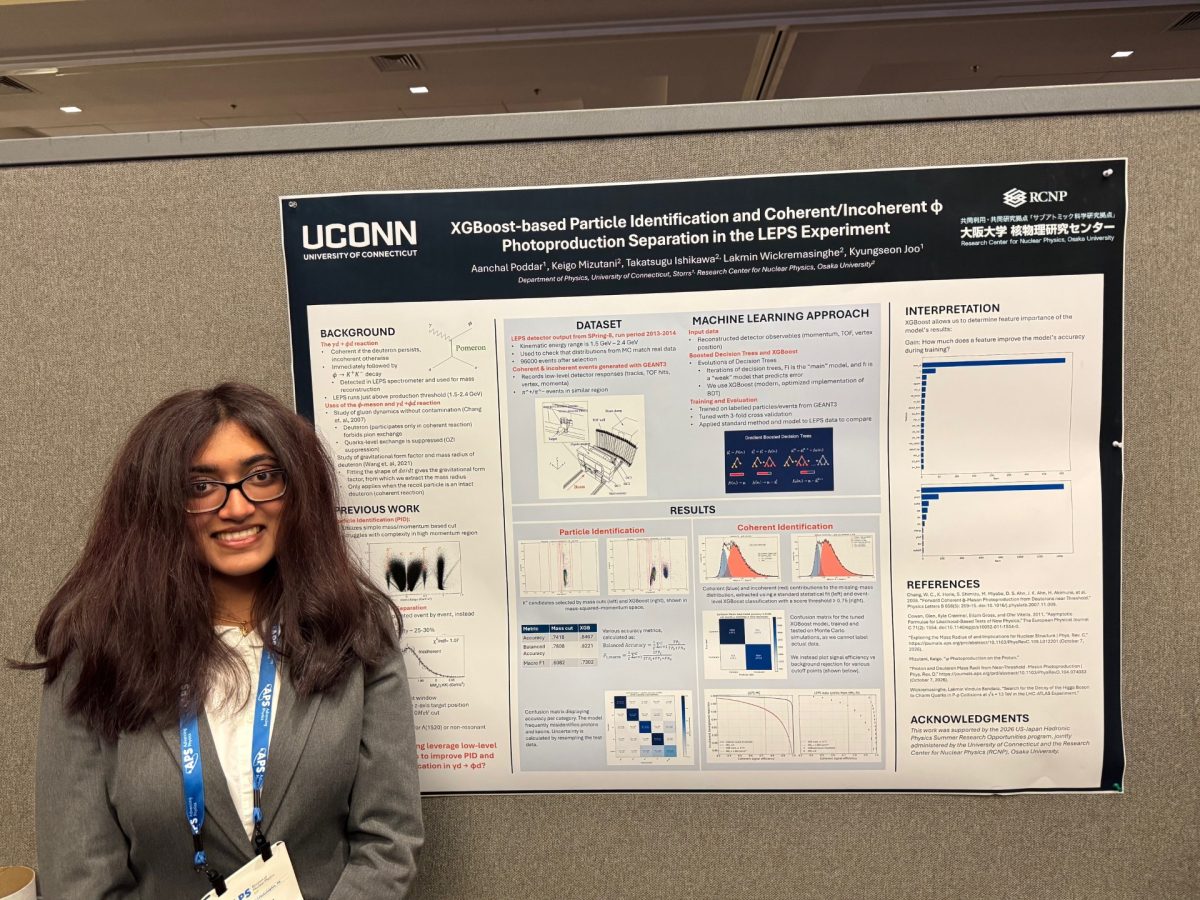
Aanchal Poddar: separating rare processes in LEPS data
Poddar presented “XGBoost-based Particle Identification and Coherent/Incoherent φ Photoproduction Separation in the LEPS Experiment.” The φ (phi) meson decays before it can be seen, so experimenters identify it from the particles it leaves behind. Her work applies XGBoost — a gradient-boosted decision-tree method strong on tabular data — to two linked jobs: identifying recorded particles, and separating two ways the φ can be produced.
In coherent production the photon interacts with an entire nucleus, which recoils as a unit; in incoherent production the φ is struck from a single nucleon. Coherent events are sensitive to gluonic structure and to how the φ interacts with nuclei, but separating them is delicate: the signal piles up at very small momentum transfer, where a target that broke apart can mimic it. A classifier trained on the detector’s response variables can sharpen that separation beyond simple selection cuts.
The analysis uses LEPS, the Laser-Electron Photon beamline at SPring-8 in Harima, Japan, which tags a polarized photon beam by scattering laser light from the synchrotron’s electron beam and directs it onto a fixed target.