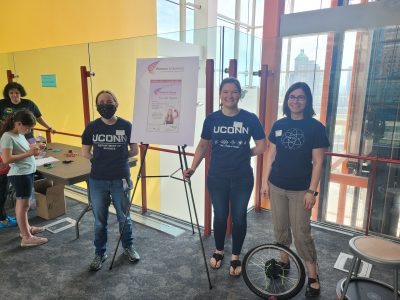
Every year, the American Physical Society (APS) sponsors CU*IP – Conference for Undergraduate Women and Gender Minorities in Physics – at several locations around the country. This year, led by Prof. Nora Berrah, UConn Physics applied to host this national conference in Storrs and our proposal was accepted for January 24-26, 2025! The purpose of the conference is to bring together over 120 undergraduates from around the country to learn about many research areas in physics and also to lean many skills for pursuing a career in Physics or Science, such as networking, applying to graduate school, finding role models in academia or industry, learning how to succeed as an underrepresented minority, etc.
While the conference is partially funded by the APS, the host institution needs to raise a substantial amount of funds. So far, we have commitments from UConn, some generous donors, such as the Ed Eyler and Karen Greer foundation, alumnus Mark Miller, and the Del Boca family, as well as the American Association for the Advancement of Science, and Mirion Technologies.
The current members of the local organizing committee, composed of faculty, staff and students, are Cara Battersby, Tom Blum, Cameron Brady, Carrie Cichocki, Simone Colombo, Meg Davis, Elena Dormidontova, George Gibson, Matt Guthrie, Adam Kolano, Luchang Jin, Dani Lipman, Jessica Mitlehne, Michael Rozman, Dave Perry, Erin Scanlon, Peter Schweitzer, Juliette Stecenko, Sarah Trallero, Kaley Wilcox, Alan Wuosmaa and Nora Berrah.
The planned events demonstrate the Physics Department’s and UConn’s commitment to helping undergraduate women and gender minorities pursue physics following their undergraduate degree by providing them the opportunity to learn about different career tracks in STEM fields, graduate studies, and various professions in physics.
We will be very grateful to receive any donations to assist the Department in hosting the conference, which will be used to cover students’ meals, accommodation and travel, as well as the invited speakers’ and panelists’ travel and accommodation. Please visit our website at: https://physics.uconn.edu/cuwip/
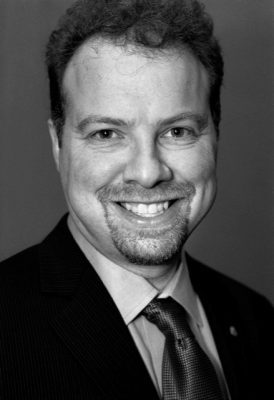 Adam Riess is a Bloomberg Distinguished Professor, the Thomas J. Barber Professor in Space Studies at the Krieger School of Arts and Sciences at Johns Hopkins University, a distinguished astronomer at the Space Telescope Science Institute and a member of the National Academy of Sciences. He received his bachelor’s degree in physics from the Massachusetts Institute of Technology in 1992 and his PhD from Harvard University in 1996. His research involves measurements of the cosmological framework with supernovae (exploding stars) and Cepheids (pulsating stars). Currently, he leads the SHOES Team in efforts to improve the measurement of the Hubble Constant and the Higher-z Team to find and measure the most distant type Ia supernovae known to probe the origin of cosmic acceleration.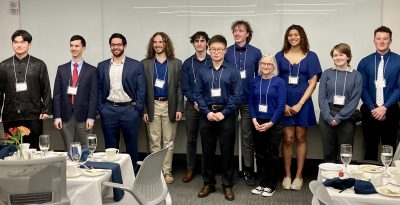

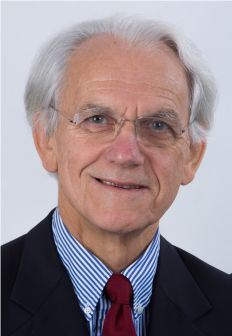 Gérard Mourou received his undergraduate education at the University of Grenoble (1967) and his Ph.D. from University Paris VI in 1973. He has made numerous contributions to the field of ultrafast lasers, high-speed electronics, and medicine. But, his most important invention, demonstrated with his student Donna Strickland while at the University of Rochester (N.Y.), is the laser amplification technique known as Chirped Pulse Amplification (CPA), universally used today. CPA revolutionized the field of optics, opening new branches like attosecond pulse generation, Nonlinear QED, and compact particle accelerators. It extended the field of optics to nuclear and particle physics. In 2005, Prof. Mourou proposed a new infrastructure, the Extreme Light Infrastructure (ELI), which is distributed over three pillars located in the Czech Republic, Romania, and Hungary. Prof. Mourou also pioneered the field of femtosecond ophthalmology that relies on a CPA femtosecond laser for precise myopia corrections and corneal transplants. Over a million such procedures are now performed annually. Prof. Mourou is a member of the U.S. National Academy of Engineering, and a foreign member of the Russian Science Academy, the Austrian Sciences Academy, and the Lombardy Academy for Sciences and Letters. He is Chevalier de la Légion d’honneur.