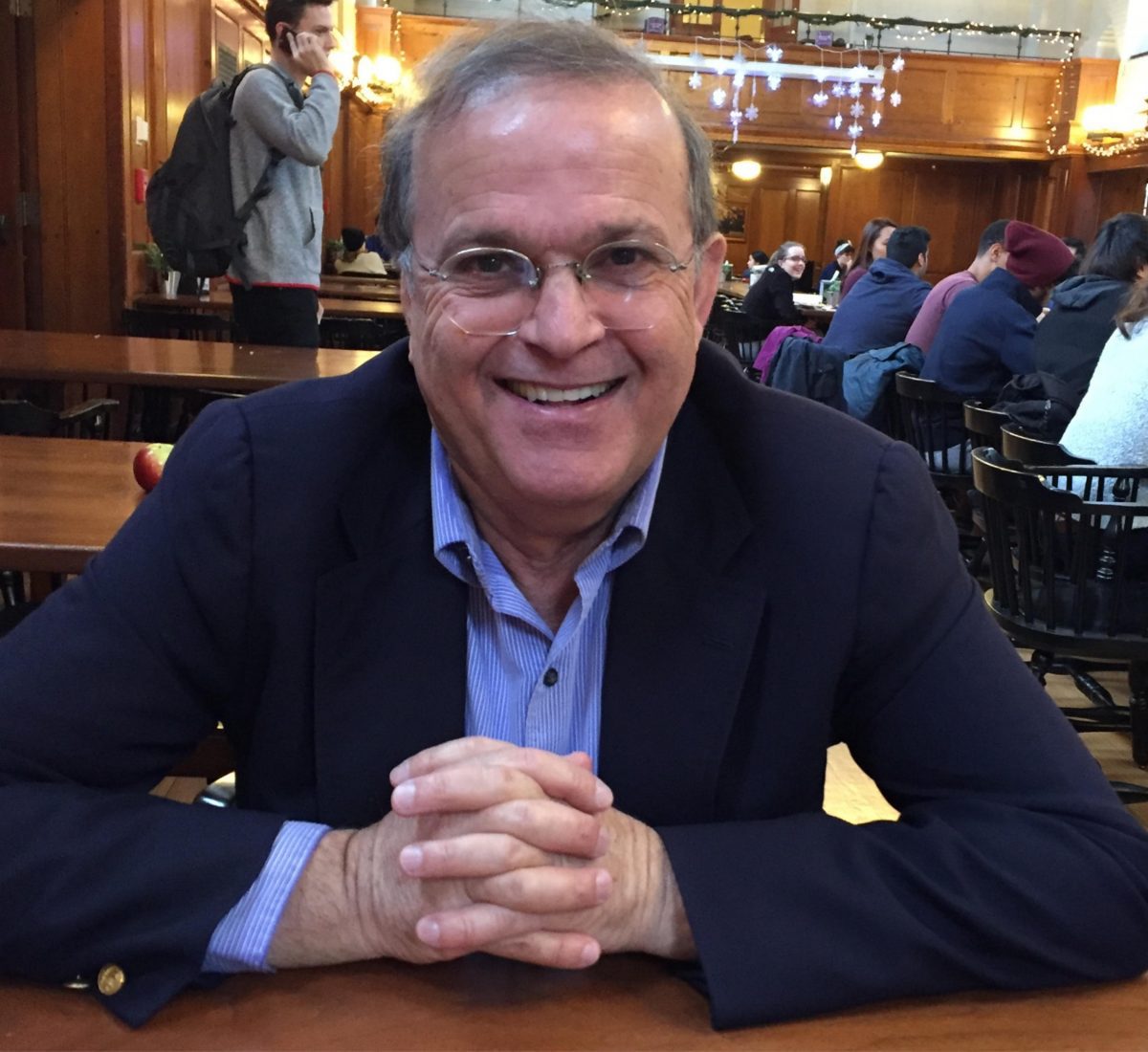
Dear Friends of UConn Physics,
While I started last year’s greeting on a somewhat apprehensive note, I remained hopeful because of the deep strengths of our department. As it turns out, I am pleased to say that this has been a positively exciting year! My one-word summary last year was turbulent. This year I chose Quantum. At the Federal, State, University, and Department level, Quantum science is a top priority, for its scientific interest, its ability to revolutionize computing, and its impact on the economy. All of this potential was summed up in a large grant proposal, called QuantumCT, to the National Science Foundation’s Regional Innovation Engines program. The proposal brought together UConn, Yale, SCSU, the State of Connecticut, and many industrial partners. On July 15, NSF announced that QuantumCT is being funded! This is a major milestone on many levels. Many faculty in the Physics Department contributed to the proposal and the award will affect much of the research in the department, from condensed matter physics, to atomic, molecular, and optical physics, to nuclear physics. It will also impact our education and outreach efforts.
Even before the QuantumCT award was announced, UConn committed to pursuing Quantum science research. As part of this effort, President Radenka Maric challenged the Physics Department to find an extraordinary world-class researcher to anchor and coordinate the quantum efforts at UConn. I am pleased to say that we found and successfully recruited such a researcher: Dr. Dmitri (Dima) Kharzeev, who will be joining us in the Fall from Stony Brook. Dima has a long and distinguished career as a well-known nuclear theorist but has made significant contributions in condensed matter physics and AMO physics, as well. He has also started several Quantum initiatives. We are very excited to welcome Dima to UConn Physics!
An important aspect of QuantumCT is workforce development and UConn Physics is contributing to this, as well. Recently, through the efforts of Profs. Hancock, Valente, Volkov, McCarron, Dunne, and Colombo, we introduced an online Quantum Certificate program targeted at engineers in industry wanting to come up to speed on the latest quantum technologies. Prof. McCarron recently created a course on quantum computing, and we will be introducing quantum mechanics throughout our curriculum. Prof. Joo is developing a course on creating Artificial Intelligence on a quantum computer – combining two of the hottest fields in science, right now. Prof. Joo and our former colleague Prof. Cote organized a second DOE-workshop on the application of Quantum Information Science to Nuclear Physics at UMass Boston. In addition, Prof. Joo received not one but two major grants (>$1 M) from the DOE: “Medium Energy Nuclear Physics Experiments,” and “Quantum Monte Carlo Simulations for Studies of the 3D Nucleon Structure.”
With all the excitement about AI and Quantum, the only other field that I can think of that generates such attention is Astrophysics, and, here too, UConn Physics stands out. Prof. Battersby and her team were highlighted in a press release, shared around the world, for their large observing program, ACES. The main release was from the European Southern Observatory with a local UConn press release. Prof. Battersby was also interviewed by Sky & Telescope, and the news was covered by more than 20 outlets, including Scientific American, the Guardian, ABC Australia, Le Monde, Washington Post.
On the local level, we are very grateful to have received generous donations to our Observatory and Planetarium, which Prof. Guthrie has been using to upgrade the Observatory and make it more freely available to the public. Both facilities continue to attract much attention from the community.
Our faculty continue to be recognized with major awards. Profs. Berrah and Santos were both inducted into the Connecticut Academy of Science and Engineering. Prof. Tandoğan received the 2026 Petit Family Foundation Women in Science Leadership Award of the Connecticut Science Center. Prof. Gai received a (second) Fulbright Award as a “Fulbright Specialist” with Tenure on the 2026-2029 Roster. Prof. Blum received a Humbolt Fellowship. Prof. Guthrie’s book: Demystifying Classical Particles, Fields, and Relativity Through the Lagrangian Formalism, has been published and available from World Scientific.
Our undergraduate students are doing very well with many accomplishments and awards. Alexander Yi has only been at UConn one year, coming straight from high school. Nevertheless, he is already a junior, on the Dean’s list, and in the Honor’s program. Moreover, he received our Mark Miller Award for best undergraduate research proposal and received an APS award to present his research at the APS-Division of Nuclear Physics (DNP) annual meeting. Owen Finch also received an award to participate in the same conference. Owen Finch and Sean Gasperini received Science Undergraduate Laboratory Internships at Brookhaven National Labs. Michael Frank and Owen Finch, performed summer research work at the Research Center for Nuclear Physics at Osaka University in Japan, organized by Prof. Joo. Finally, our Katzenstein Prize for best undergraduate research went to Jefferson Tang for “Dynamical signatures and control of time-reversal symmetry breaking in twisted nodal superconductors.”
Prof. Pablo Jarillo-Herrero, from MIT, presented our Katzenstein Distinguished Lecture titled “Magic Angle Graphene: The Twist and Shout of Quantum Materials.” Despite the non-standard timing of the lecture, it was exciting and well-attended.
Our Edward Pollack Distinguished Lecture was presented by Prof. Vladan Vuletić, Lester Wolfe Professor of Physics at MIT. The lecture was titled “The Quantum Age: from Atomic Clocks to Quantum Computers” and fit perfectly with our current excitement about all things Quantum!
Finally, I would like to cordially invite you to attend our 28th annual Katzenstein Distinguished Lecture on Friday, October 16, 2026, which will be held in our department. This year’s speaker is Prof. Federico Capasso, Robert L. Wallace Professor of Applied Physics and Vinton Hayes Senior Research Fellow in Electrical Engineering at Harvard University. Dr. Capasso is known for his pioneering work on quantum cascade lasers and has received numerous prizes and awards, including the Arthur L. Schawlow Prize in Laser Science. He is also a member of the
National Academy of Sciences. I hope you can all attend and catch up on everything that is going on in the department. I look forward to seeing you there!
Sincerely,
George Gibson
Department Head, Physics