Web cookies (also called HTTP cookies, browser cookies, or simply cookies) are small pieces of data that websites store on your device (computer, phone, etc.) through your web browser. They are used to remember information about you and your interactions with the site.
Purpose of Cookies:
Session Management:
Keeping you logged in
Remembering items in a shopping cart
Saving language or theme preferences
Personalization:
Tailoring content or ads based on your previous activity
Tracking & Analytics:
Monitoring browsing behavior for analytics or marketing purposes
Types of Cookies:
Session Cookies:
Temporary; deleted when you close your browser
Used for things like keeping you logged in during a single session
Persistent Cookies:
Stored on your device until they expire or are manually deleted
Used for remembering login credentials, settings, etc.
First-Party Cookies:
Set by the website you're visiting directly
Third-Party Cookies:
Set by other domains (usually advertisers) embedded in the website
Commonly used for tracking across multiple sites
Authentication cookies are a special type of web cookie used to identify and verify a user after they log in to a website or web application.
What They Do:
Once you log in to a site, the server creates an authentication cookie and sends it to your browser. This cookie:
Proves to the website that you're logged in
Prevents you from having to log in again on every page you visit
Can persist across sessions if you select "Remember me"
What's Inside an Authentication Cookie?
Typically, it contains:
A unique session ID (not your actual password)
Optional metadata (e.g., expiration time, security flags)
Analytics cookies are cookies used to collect data about how visitors interact with a website. Their primary purpose is to help website owners understand and improve user experience by analyzing things like:
How users navigate the site
Which pages are most/least visited
How long users stay on each page
What device, browser, or location the user is from
What They Track:
Some examples of data analytics cookies may collect:
Page views and time spent on pages
Click paths (how users move from page to page)
Bounce rate (users who leave without interacting)
User demographics (location, language, device)
Referring websites (how users arrived at the site)
Here’s how you can disable cookies in common browsers:
1. Google Chrome
Open Chrome and click the three vertical dots in the top-right corner.
Go to Settings > Privacy and security > Cookies and other site data.
Choose your preferred option:
Block all cookies (not recommended, can break most websites).
Block third-party cookies (can block ads and tracking cookies).
2. Mozilla Firefox
Open Firefox and click the three horizontal lines in the top-right corner.
Go to Settings > Privacy & Security.
Under the Enhanced Tracking Protection section, choose Strict to block most cookies or Custom to manually choose which cookies to block.
3. Safari
Open Safari and click Safari in the top-left corner of the screen.
Go to Preferences > Privacy.
Check Block all cookies to stop all cookies, or select options to block third-party cookies.
4. Microsoft Edge
Open Edge and click the three horizontal dots in the top-right corner.
Go to Settings > Privacy, search, and services > Cookies and site permissions.
Select your cookie settings from there, including blocking all cookies or blocking third-party cookies.
5. On Mobile (iOS/Android)
For Safari on iOS: Go to Settings > Safari > Privacy & Security > Block All Cookies.
For Chrome on Android: Open the app, tap the three dots, go to Settings > Privacy and security > Cookies.
Be Aware:
Disabling cookies can make your online experience more difficult. Some websites may not load properly, or you may be logged out frequently. Also, certain features may not work as expected.
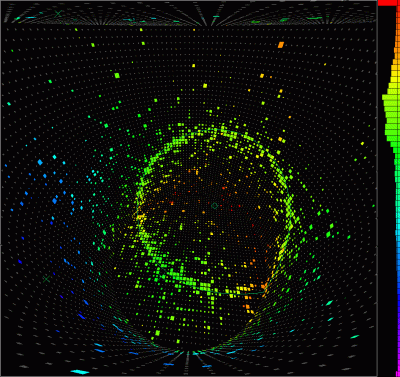
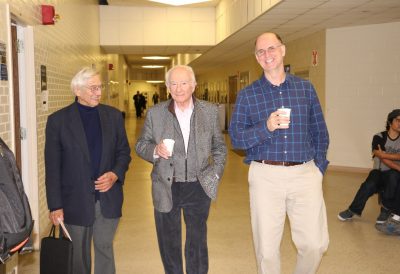
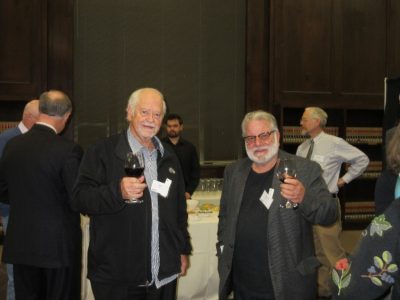
The 21st Annual Katzenstein Distinguished Lecture was hosted by the UConn Physics Department, featuring Dr. Takaaki Kajita, 2015 Nobel Prize Winner from the University of Tokyo, speaking on “Oscillating Neutrinos.” After the lecture, a banquet with the speaker was held for members and guests of the department. We enjoyed welcoming alumni and visitors to the department for this special occasion, made possible by a generous gift from UConn Physics alumnus Henry Katzenstein and his family.
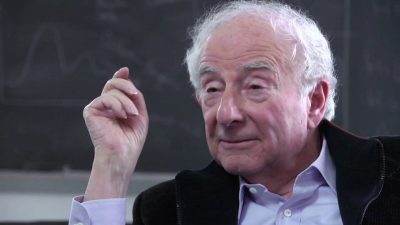
Leon Cooper, 1972 Nobel Laureat delivered the Distinguished Katzenstein lecture at UConn in October, 2016
The Katzenstein Distinguished Lectures series continued in Fall 2016 for its 19th year, with an October 28, 2016 lecture by Professor Leon N. Cooper of Brown University, entitled “On the Interpretation of the Quantum Theory: Can Free Will And Locality Exist Together In The Quantum Theory?” Professor Cooper shared the 1972 Nobel Prize in Physics with Professors J. Bardeen and J. R. Schrieffer. The Nobel Prize was awarded for the first microscopic theory of superconductivity, now known as the BCS Theory. Superconductivity as evidenced by the disappearance of electrical resistivity was first observed in Mercury by Kamerlingh Onnes in 1911. Immediately, many theorists including Albert Einstein, set out to explain this newly observed phenomena. However it was not until 1933 that the essential property of magnetic flux exclusion was observed by Meissner and Ochsenfeld. No successful microscopic theory was developed until the 1957 Physical Review Paper that developed the BCS theory. A crucial element for the theory was published in a short letter to the Physical Review in 1956 by Leon Cooper, entitled ‘Bound Electron Pairs, in a degenerate Fermi Gas’. These pairs are now commonly referred to as ‘Cooper Pairs’.
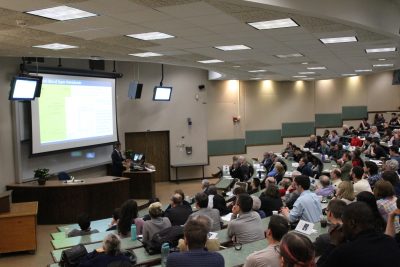
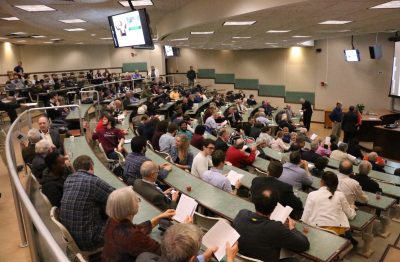
The 2016 lecture took place in Physics Building Lecture Room P-36, and an excellent attendance included physics undergraduates, graduate students, faculty from Physics and other departments, and a number of UConn Physics alumni. Prior to the lecture, Professor Cooper met informally with Physics students in the Physics Library, and then met people at a reception that preceded the lecture. Following the lecture, Professor Cooper joined with Henry Katzenstein’s son David, a Professor at Stanford Medical School, along with faculty, staff, alumni and guests for a gala dinner at the University of Connecticut’s Foundation Building. The Katzenstein Lectures are made possible by an endowment established by the late Dr. Henry S. Katzenstein and his wife Dr. Constance A. Katzenstein. Cornell Professor David Lee (1996 Nobel Laureate in Physics and 1956 M. S. alumnus of UConn) gave the first lecture of the current series of annual lectures by Nobel Laureates, in 1997. Henry Katzenstein received the very first Ph.D. in physics from our Department in 1954 after only three years as a graduate student here.
UConn Physics lecture hall PB-36 filled for 2016 Katzenstein Distinguished Lecture
This story was published in the University of Connecticut 2017 Annual Newsletter.