Web cookies (also called HTTP cookies, browser cookies, or simply cookies) are small pieces of data that websites store on your device (computer, phone, etc.) through your web browser. They are used to remember information about you and your interactions with the site.
Purpose of Cookies:
Session Management:
Keeping you logged in
Remembering items in a shopping cart
Saving language or theme preferences
Personalization:
Tailoring content or ads based on your previous activity
Tracking & Analytics:
Monitoring browsing behavior for analytics or marketing purposes
Types of Cookies:
Session Cookies:
Temporary; deleted when you close your browser
Used for things like keeping you logged in during a single session
Persistent Cookies:
Stored on your device until they expire or are manually deleted
Used for remembering login credentials, settings, etc.
First-Party Cookies:
Set by the website you're visiting directly
Third-Party Cookies:
Set by other domains (usually advertisers) embedded in the website
Commonly used for tracking across multiple sites
Authentication cookies are a special type of web cookie used to identify and verify a user after they log in to a website or web application.
What They Do:
Once you log in to a site, the server creates an authentication cookie and sends it to your browser. This cookie:
Proves to the website that you're logged in
Prevents you from having to log in again on every page you visit
Can persist across sessions if you select "Remember me"
What's Inside an Authentication Cookie?
Typically, it contains:
A unique session ID (not your actual password)
Optional metadata (e.g., expiration time, security flags)
Analytics cookies are cookies used to collect data about how visitors interact with a website. Their primary purpose is to help website owners understand and improve user experience by analyzing things like:
How users navigate the site
Which pages are most/least visited
How long users stay on each page
What device, browser, or location the user is from
What They Track:
Some examples of data analytics cookies may collect:
Page views and time spent on pages
Click paths (how users move from page to page)
Bounce rate (users who leave without interacting)
User demographics (location, language, device)
Referring websites (how users arrived at the site)
Here’s how you can disable cookies in common browsers:
1. Google Chrome
Open Chrome and click the three vertical dots in the top-right corner.
Go to Settings > Privacy and security > Cookies and other site data.
Choose your preferred option:
Block all cookies (not recommended, can break most websites).
Block third-party cookies (can block ads and tracking cookies).
2. Mozilla Firefox
Open Firefox and click the three horizontal lines in the top-right corner.
Go to Settings > Privacy & Security.
Under the Enhanced Tracking Protection section, choose Strict to block most cookies or Custom to manually choose which cookies to block.
3. Safari
Open Safari and click Safari in the top-left corner of the screen.
Go to Preferences > Privacy.
Check Block all cookies to stop all cookies, or select options to block third-party cookies.
4. Microsoft Edge
Open Edge and click the three horizontal dots in the top-right corner.
Go to Settings > Privacy, search, and services > Cookies and site permissions.
Select your cookie settings from there, including blocking all cookies or blocking third-party cookies.
5. On Mobile (iOS/Android)
For Safari on iOS: Go to Settings > Safari > Privacy & Security > Block All Cookies.
For Chrome on Android: Open the app, tap the three dots, go to Settings > Privacy and security > Cookies.
Be Aware:
Disabling cookies can make your online experience more difficult. Some websites may not load properly, or you may be logged out frequently. Also, certain features may not work as expected.
The Department of Physics is hosting UConn-NSF summer school on Parton Saturation and Electron Ion Collider (EIC). The School will take place in Storrs, from August 1 to August 10, 2023. The school chair is Professor Alex Kovner. The school website can be found at https://www.phys.uconn.edu/Conferences/saturation-eic/.
The Electron-Ion Collider is the next big experiment in high-energy nuclear physics. It is going to address a plethora of questions about the structure of protons and nuclei. One of the main exciting phenomena that it is intended to clarify is the manifestations of parton saturation. This has been predicted to occur in hadrons at high energy as well as in nuclei at lower energies. Although tantalizing hints of saturating behavior have been observed at Relativistic Heavy Ion Collider (RHIC) in Brookhaven National Lab and the Large Hadron Collider (LHC) at CERN, no cut-and-dry experimental case has been made for it yet. We hope that the experiments on nuclei at EIC will provide a convincing case for saturation. Another important aspect of EIC physics is scattering on polarized proton beams, which should improve our understanding of the so-called “proton spin crisis”.
The school is intended to graduate students and postdocs who want to extend their physics horizons or plan to pursue research in this or related areas. A preliminary list of lecturers at the school includes A. Mueller (Columbia), O.Hen (MIT), N. Armesto (Santiago de Campostela), A. Dumitru (CUNY, Baruch College), Yu. Kovchegov (Ohio State), L. Jin (UConn), V. Skokov (North Carolina State), B. Schenke (BNL). The schedule of lectures is available on the school website at https://www.phys.uconn.edu/Conferences/saturation-eic/
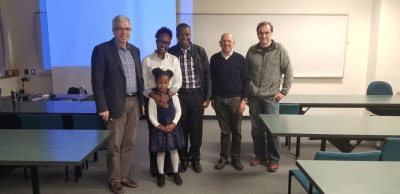
Jeff Schweitzer (second from right) shown together with PhD student Fridah Mokaya (second from left) following her PhD defense in May, 2018. Also shown standing beside Fridah are husband Jonathan and daughter Jenise, with faculty advisors Richard Jones (left) and Peter Schweitzer (right).
Jeff Schweitzer passed away unexpectedly last year on May 31, 2022 in his home in Ridgefield, CT. Jeff was a faculty member in the physics department for 25 years (1997-2022). Jeff earned his B.S. in Physics from the Carnegie Institute of Technology (1967), and his M.S. (1969) and Ph.D. (1972) in physics from the Purdue University conducting research in low-energy nuclear physics. After his postdoctoral research at the California Institute of Technology (1972–1974) he worked as scientific advisor at Schlumberger-Doll Research (1974–1996) where he employed his expertise in nuclear experimental techniques to applications in geology and developed several patents. Jeff served for 35 years on the editorial boards of the Journal of Nuclear Geophysics (1987-1993) and Applied Isotopes and Radiation (1993-2022). A skilled nuclear experimental physicist, Jeff applied his expertise to a wide variety of fields: from fundamental experimental nuclear physics, to astrophysics, to studies of the nanoscale kinetics in cement chemistry, to instrumentation development with applications in medical physics, forensic science, and planetary mission satellites and landers.
Jeff taught at the Waterbury campus for several years, and was a devoted mentor for his students. At UConn, he was the PhD advisor for Nada Jevtic (Phd 2003) who is now faculty at the Bloomsburg University, Tim Spillane (PhD 2008) who works now as data scientist at Hiya Inc, and James Zickefoose (PhD 2011) who is now Senior Research Scientist at Mirion Technologies, Inc. in Meriden, CT. Jeff was the mentor and co-advisor for many more PhD students including Fridah Mokaya who was Jeff’s most recent advisee. Jeff also mentored junior UConn faculty including Howard Winston and Peter Schweitzer (not related to Jeff despite the same last name).
Howard Winston recalls that Jeff went out of his way to help him during his early days at UConn. He was extraordinarily generous with his time explaining his teaching philosophy and sharing course materials. While doing so, Jeff was never overly didactic. He enjoyed talking about areas where his approaches could be customized or improved. Jeff loved to keep in touch to see how things were going. In common with others, Howard misses his warm smile and sage advice.
Fridah Mokaya recalls: “I will forever treasure this memory as it is a constant reminder of Jeff’s dedication as an advisor and mentor. Jeff greatly influenced the career path I took, I remember when I was not certain of what to do or which path to take post graduation, his words of wisdom and guidance enabled me Identify my strength and passion. He was not only an advisor and mentor but also a great friend, who would constantly call, text, email and visit to check on how everything was progressing. I will greatly miss his advice and words of wisdom.” The picture taken after Fridah’s PhD defense shows Jeff Schweitzer (second from the right) together with Fridah, her husband and daughter (middle), Richard Jones (left, main advisor) and Peter Schweitzer (right, associate advisor).
More information about Jeff can be found in the news article of the Institute of Materials Science, in Jeff’s obituary and in the article in the journal Applied Radiation and Isotopes. Many of Jeff’s articles and scientific contributions can be found on the Research Gate website.
Galaxy clusters are the most massive objects in the Universe: a single cluster contains anything from a hundred to many thousands of galaxies, alongside collections of plasma, hot X-ray emitting gas, and dark matter. These components are held together by the cluster’s own gravity. Understanding such galaxy clusters is crucial to pinning down the origin and continuing evolution of our universe. An article recently published in Proceedings of the National Academy of Sciences describes using of machine learning algorithms to solve a fundamental problem in astrophysics: inferring the mass of galaxy clusters. “Measuring how many clusters exist, and then what their masses are, can help us understand fundamental properties like the total matter density in the universe, the nature of dark energy, and other fundamental questions,” says co-author and UConn Professor of PhysicsDaniel Anglés-Alcázar.
A University chapter of Optica (formerly known as OSA), the largest professional society for Optics and Photonics, has started at UConn. Physics graduate students Zhanna Rodnova and Kevin Watson, and Electrical and Computer Engineering graduate student Gokul Krishnan started the chapter in the Fall of 2022 to help students, undergraduate, and graduate, learn more about the world of optics and the professional opportunities within the field. Chapter of Optica, UConn is also organizing tours of laser and optics companies to give students further insight into possible careers after graduation. Additionally, the Optica Chapter holds social events, with the next social on Wednesday, April 12th at 6:30 pm at Hops 44, where everyone is welcome to learn more about optics and photonics research.
On April 21st, the Chapter will host its first Traveling Lecturer. Dr. Gregory Quarles, CEO of Applied Energetics, Inc. and former Chief Scientific Officer of Optica, to talk about career paths for students and early-career professionals. The colloquium will be at 3:30 pm in GW-002, with refreshments served in the Gant Light plaza. For any information, contact uconnoptica@gmail.com.
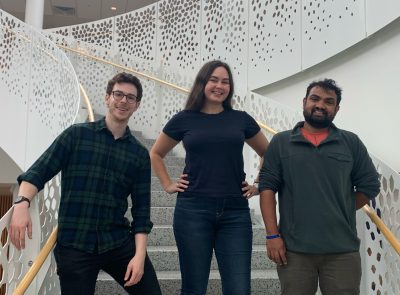
Founding members of the UConn Chapter of Optica (from left): Kevin Watson,, Zhanna Rodnova, and Gokul Krishnan
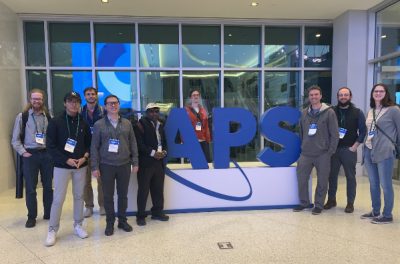
This year, international conferences have begun to come back into their pre-pandemic form. For the American Physical Society’s annual March Meeting, it was bigger than ever with over 12,000 participants in the world’s largest meeting ever devoted to physics. UConn showed strong as graduate students, postdoctoral fellows, research scientists, and faculty researchers attended the meeting in Las Vegas March 5-10 and showcased their newest results. The team rolled in deep and gave diverse presentations to an international audience on many topics in condensed matter physics, ranging from high-fidelity electronic structure calculations and material modeling, synthesis and characterization of new materials with competing states, advances in industrial science related to advanced manufacturing, synchrotron-based investigations of correlated materials, nanoscale magnetic imaging studies, the development of new cryogenic instrumentation, twistronic effects, vortices in topological materials and circuit-based quantum information science. See you next year!
From left to right: Jacob Pfund, Bochao Xu, Joshua Bedard, Ilya Sochnikov, Gayanath Fernando, Jacob Franklin, Jason Hancock, Donal Sheets, Kaitlin Lyszak
Not pictured: Krishna Joshi, Guang Chen (MSE), Jorge Chavez, Priya Sharma, Alexander Balatsky, Pavel Volkov.
Gary Dean Bent, 82, a former assistant head of the Physics Department at the University of Connecticut for 23 years, passed away on Friday, March 3, 2023. He was born on October 9, 1940, in Battle Creek, Michigan. Growing up in Florida, he studied at the Georgia Institute of Technology where he earned Bachelor’s and Master’s degrees in Electrical Engineering and Physics. He received his Ph.D. in physics from the University of Connecticut. He was an Ordnance Corps officer in the United States Army for 12 years, serving in several military research centers and at the Military Academy at West Point. He served as assistant head of the physics department at the University of Connecticut for 23 years. While at UCONN he published numerous articles in scientific journals, worked closely with graduate students, taught courses in Physics and environmental science, and was an enthusiastic researcher. Over the years he developed a sense of how physics could be taught at the high school level to ensure student success at the college level. He pursued Connecticut teaching certification in physics and chemistry and after retiring from UCONN he went on to teach physics for UCONN credit at E.O. Smith High School in Storrs. A dedicated teacher, he made the classroom a space for fun and creative learning, using exciting experiments to demonstrate the theories of physics while dressed as a wizard! After retirement from E.O. Smith, he spent time traveling and volunteering his time to combat climate change. He was a founding member of Eastern Connecticut Green Action.
Gary touched many lives and will be greatly missed. A Celebration of Life will be held at the Unitarian Society of Hartford at a later date. In lieu of flowers, a donation in Gary’s memory can be made to the Covenant Soup Kitchen in Willimantic Connecticut at covenantsoupkitchen.org, Eastern Connecticut Green Action at easternconnecticutgreenaction.com or Food and Water Watch at foodandwaterwatch.org.
Gary Bent’s scholarly publications are available at https://www.researchgate.net/scientific-contributions/Gary-Bent-84804712
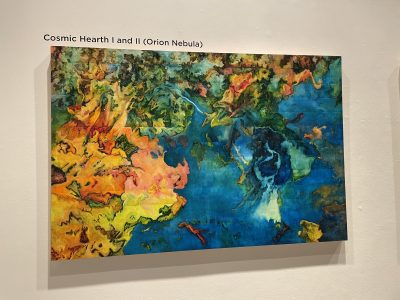
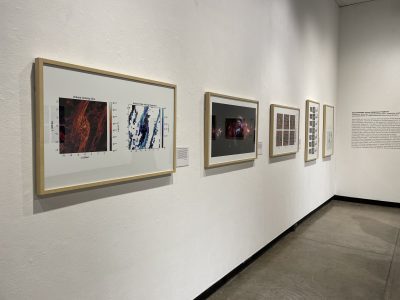
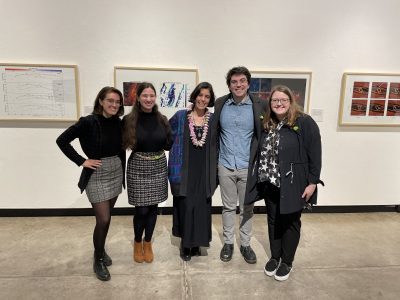
Prof. Cara Battersby’s research group, the Milky Way Laboratory, was invited to collaborate with Genevieve de Leon, the 2022-23 Koopman Distinguished Chair in the Painting Department at the University of Hartford, for an exhibition focused on the intersection between the Maya calendrical cycles and scientific studies of the cosmos.
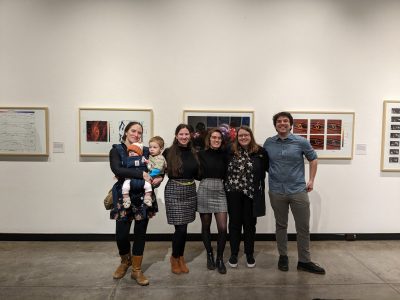
From the Milky Way Laboratory, H Perry Hatchfield, Jennifer Wallace, Dani Lipman, and Samantha Brunker contributed scientific figures that are displayed as part of the exhibition. These figures demonstrate the ongoing research focused on understanding the universe around us through the use of data and scientific analysis. These figures balance well with Genevieve de Leon’s original, large-scale paintings of constellations in the Maya Zodiac which were created in a methodical, focused way similar to how large-sky surveys are observed. Genevieve has studied Maya timekeeping extensively, and, through this exhibit, focuses on the intersection of various systems of knowledge.
Additionally, the exhibition includes multimedia work made by indigenous artists in the Native Youth Arts Collective and students at the Hartford Art School which focus on personal connections with the night sky.
The exhibit, “To Order the Days/Para Ordenar Los Días”, is located in the Donald and Linda Silpe Gallery at the University of Hartford, and will be available from February 23, 2023, to March 25, 2023.
The Conversation interviewed Prof. Jonathan Trump about his recent work with the James Webb Space Telescope (JWST), with an article and podcast interview available at this link. The interview includes discussion of Prof. Trump’s recent journal paper that used spectroscopic observations from JWST to understand the chemical enrichment of galaxies in the early Universe.
The 2023 High Energy Astrophysics Division’s Early-Career Prize is awarded to Dr. Chiara Mingarelli for her leadership in the analysis of pulsar timing array data and her contributions to our understanding of the stochastic gravitational wave background.
For more information about the Prize, see https://head.aas.org/awards/earlycareer/earlycareer.prize.html
Daniel McCarron, a physics professor, received a grant from the Air Force Office of Scientific Research for his work analyzing the quantum mechanical behavior of a simple hydrocarbon molecule: CH, or methylidyne. A highly reactive gas, methylidyne is abundant in the interstellar medium, and its simple composition promises to allow researchers to study the role of quantum mechanics within organic chemistry.
In order to expose the quantum nature of these molecules, Prof. McCarron has devised a way to cool them down to a millionth of a degree above absolute zero using laser light. At such a low temperature, “quantum effects are amplified and can reveal themselves in the lab,” he says. “You don’t really get that in a beaker at room temperature – things just happen too quickly and too chaotically.”
The AFOSR is funding the purchase of a high-powered laser to assist in slowing down beams of CH radicals from about 100 meters per second to several centimeters per second. This laser-cooling and trapping technology will allow amplifying and better study of the quantum behavior of this organic molecule, with an eye toward furthering scientific knowledge about the role of quantum mechanics in chemical reactions in general—a field where successful research has been scarce.
 h group,